The map makes it look simple: point west, drive until you hit Nevada. In practice, a Texas-to-Vegas drive runs anywhere from about 1,225 miles out of Dallas to nearly 1,475 miles out of Houston, and most of it crosses genuinely remote desert terrain where a breakdown or a coverage gap matters more than it would on a shorter trip closer to home.
Two Real Route Options
The northern route runs through the Texas Panhandle via US-287 and I-40, passing through Amarillo, across New Mexico through Albuquerque, and into Arizona through Flagstaff and Kingman before dropping into Las Vegas. From Dallas-Fort Worth, this is roughly 1,225 miles and about 18 hours of driving time under ideal conditions, which in practice usually means splitting the trip across two days with an overnight stop somewhere in New Mexico.
The southern route follows I-20 or I-10 west through El Paso, across southern New Mexico and Arizona through Tucson and Phoenix, then north toward Las Vegas. From Houston, this route runs closer to 1,475 miles and about 21 hours nonstop. This option makes more sense if you’re starting from South or Central Texas, since it avoids doubling back north before heading west.
Neither route is meaningfully faster once you account for realistic driving days, so the choice usually comes down to where in Texas you’re starting and whether you’d rather see the high plains and Grand Canyon country or the low desert through Arizona.
Desert Heat Is the Real Vehicle Risk, Not the Distance
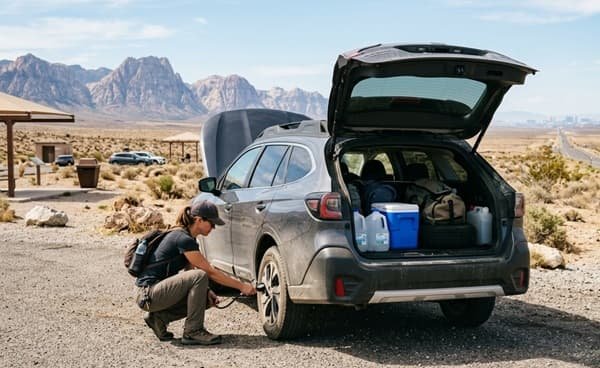
Both routes spend significant time in genuinely harsh desert terrain, particularly across New Mexico and Arizona, where summer temperatures routinely exceed 100 degrees and pavement temperatures run considerably higher. This is where mechanical failures happen, not usually from the miles themselves but from heat stress on components that are already marginal.
Before a trip like this, it’s worth checking your coolant level and condition, since an aging or low coolant system is one of the most common causes of a desert breakdown. Check tire tread and pressure carefully too. Underinflated tires generate more heat at highway speed, and combined with desert pavement temperatures, that’s a real blowout risk on a stretch where the shoulder can be miles from any shade or service. If your car is older or has any known cooling system issues, this is the trip to get it checked before you leave, not after something fails in the middle of New Mexico.
Services Thin Out Fast Once You Leave the Interstate Towns
Both routes are interstate the whole way, which helps, but the distance between towns with real services, gas, food, a mechanic, still runs longer than most Texas drivers are used to. Stretches of I-40 through eastern New Mexico and stretches of I-10 through southern New Mexico and Arizona can run 60 to 90 miles between meaningful services. If you’re driving at night or during extreme heat, keep your gas tank from dropping below a quarter, and carry water in the car regardless of season, since a breakdown in this terrain is a genuinely different situation than one on a busy Texas freeway.
Your Texas Policy Still Covers You in Nevada
This is worth stating plainly because it’s a common point of confusion. A standard auto insurance policy, including one written to meet Texas’s 30/60/25 minimum liability requirement under Tex. Transp. Code §601.072, provides coverage anywhere in the United States, not just within the state where it was issued. You don’t need a separate policy to drive through New Mexico, Arizona, or Nevada on this trip. Your car insurance Texas policy travels with you, and your liability, collision, and comprehensive coverage all apply the same way they would on a Texas highway.
What’s worth checking before you go is whether your liability limits are adequate for a long interstate trip through unfamiliar terrain, rather than whether you technically have coverage at all. If you’re carrying Texas’s bare state minimum, it’s worth considering whether that’s enough protection for a multi-day drive through several states, particularly given how a serious accident’s cost can exceed those limits regardless of which state it happens in.
If You’re Relocating, Not Just Visiting
The insurance picture changes if this drive is a one-way move rather than a trip you’re driving home from. Nevada requires proof of insurance from a Nevada-licensed carrier to register a vehicle in the state, so an out-of-state policy, even a valid Texas one, isn’t accepted for Nevada registration purposes once you’re establishing residency there. New residents get 30 days to register a vehicle and get a Nevada driver’s license after the move, so it’s worth lining up affordable car insurance in las vegas options before you arrive rather than after, particularly since Nevada’s minimum liability requirement of 25/50/20 under NRS 485.185 is actually somewhat lower than what Texas requires, and matching your old Texas coverage rather than defaulting to Nevada’s lower floor is worth a deliberate decision, not an accident of paperwork.
Roadside Assistance Matters More on This Trip Than a Local Drive
Given how remote parts of this route genuinely are, confirm your roadside assistance coverage actually includes long-distance towing, not just a short local call. A tow from a remote stretch of I-40 in eastern New Mexico or I-10 in southern Arizona can run considerably more than a tow within city limits, and it’s worth knowing what your policy covers before you’re the one calling from the shoulder.
A Practical Checklist Before You Leave
- Get your cooling system and tires checked, particularly if the car is more than a few years old or hasn’t had recent service.
- Confirm your roadside assistance covers long-distance towing, not just local calls.
- Check that your liability limits are adequate for a multi-state trip, not just the legal minimum.
- Carry water and keep your gas tank above a quarter through the remote stretches, regardless of season.
- Time your desert driving for early morning or evening in summer months, when both traffic and heat stress on the vehicle are lower.
The National Highway Traffic Safety Administration’s vehicle safety information is worth a look before a long desert drive like this, particularly its guidance on pre-trip vehicle checks and heat-related breakdown risks, since these are genuinely different considerations than a shorter regional drive.
The Bottom Line
A Texas-to-Vegas drive is long, but it’s not complicated, as long as the vehicle is genuinely ready for sustained desert heat and you’ve confirmed your coverage actually fits a multi-state trip rather than assuming it does. Whether you take the northern route through Amarillo and Flagstaff or the southern route through El Paso and Phoenix, the real risk on this drive lives in the desert stretches between towns, not the mileage total itself.