That pedestal fan sitting in your living room corner looks harmless enough. It runs quietly, keeps the room bearable through May and June, and costs a fraction of what an air conditioner does to buy. What most households never actually calculate is what it costs to run and over an Indian summer, that number is less innocent than it appears.
Pedestal fans are one of the most used electrical gadgets in households in India. Before anything else, you need to know how much power your pedestal fan consumes during each season.
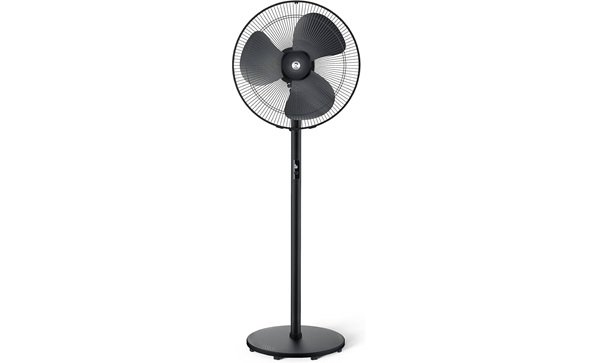
What a Conventional Pedestal Fan Actually Draws
The best pedestal fans found in India have their energy consumption rate varying from 50 to 90 watts per hour based on their speed and size since they are induction motor-based. The consumption level of a pedestal fan of size 400mm running at moderate speed is about 60-70 watts.
It may look quite a small amount. However, let us multiply it by its actual operating hours.
If we take into account the 12 hours usage for five months from April to August when the temperature remains high across most regions in North and Central India, then the amount of electricity consumed by this fan amounts to 0.065 units per hour, i.e., 0.78 units per day. Consequently, 117 units of electricity will be consumed in total of 150 days.
With the electricity tariff rate being ₹7 per unit, which can be taken as an average tariff charged by different electricity boards in Indian states including Maharashtra, Rajasthan, and Uttar Pradesh, then the total cost would be about ₹820 per summer. For two pedestal fans, the price rises to over ₹1,600 per annum!
Where BLDC Motors Change the Calculation
BLDC Brushless Direct Current motors operate on an entirely different mechanical principle than conventional induction motors. Instead of generating torque through electromagnetic induction, which inherently wastes energy as heat, BLDC motors use permanent magnets and electronic commutation. The result is the same airflow delivered at dramatically lower wattage.
The typical wattage used by an equivalent-sized BLDC pedestal fan will be anywhere from 25 watts to 35 watts. This is a difference of about 54 percent in energy consumption for 150 days when you use an average of 30 watts daily for 12 hours.
That is about half the amount of power consumed by the ordinary one, which uses 117 units. The saving per fan across one summer sits between ₹400 and ₹450 at standard domestic tariff rates. Across two fans over five years accounting for modest annual tariff increases the cumulative saving runs comfortably above ₹4,500.
The Real Cost Comparison Over Five Years
This is where the conversation shifts from interesting to financially relevant.
| Factor | Conventional Fan | BLDC Fan |
| Average wattage | 65W | 30W |
| Units consumed per summer | ~117 units | ~54 units |
| Annual electricity cost | ~₹820 | ~₹380 |
| 5-year electricity cost | ~₹4,100 | ~₹1,900 |
| Typical purchase price | ₹2,000 – ₹3,500 | ₹4,500 – ₹7,000 |
| 5-year total cost of ownership | ~₹6,600 | ~₹6,900 |
The upfront price gap closes entirely within five years and that’s using conservative electricity tariff figures. In states with higher domestic rates or households running fans beyond 12 hours daily, the BLDC option breaks even faster and generates net savings from year three onwards.
Other Factors That Affect What You’re Actually Paying
Electricity tariff is only one variable. A few others that genuinely affect the final number:
- Usage patterns of fan speeds: Traditional fans become less efficient when used at high speeds because of the friction produced by the motor. BLDC fans remain nearly linearly efficient at all speeds, which means that homes using their fans at maximum speeds will enjoy greater savings than average.
- Inverter compatibility: BLDC pedestal fans run efficiently on inverter power during outages, drawing less from the battery and extending backup duration. For households in regions with frequent load shedding much of Bihar, Jharkhand, and rural Uttar Pradesh this is a practical daily advantage, not just a theoretical one.
- Motor lifespan: Conventional induction motors in budget pedestal fans typically last seven to ten years under daily use. BLDC motors are rated for significantly longer operational life, which shifts the replacement cost calculation further in their favour over a ten-year horizon.
Conclusion
The pedestal fan you’ve been running without a second thought is costing more than its price tag suggests. Not dramatically but consistently, every day, across every summer. The savings from switching to a BLDC model aren’t life-changing in isolation. Across two fans, five summers, and rising electricity tariffs, they’re genuinely meaningful.
The question isn’t really whether BLDC pedestal fans are worth the premium. The numbers answer that clearly enough. The more honest question is how many summers you’re willing to pay extra for before making the switch.